What We Do
(and how we do it)
Noise Monitoring for OSHA Compliance
A workplace noise survey is the foundation of an effective hearing conservation program. We provide a thorough, real-world assessment of employee noise exposure and workplace sound levels, delivering results that are both OSHA-compliant and easy to understand.
All surveys are conducted personally by Dr. Luke Grossi, an experienced occupational audiologist, ensuring expert-level accuracy and interpretation from start to finish.
OUR APPROACH:
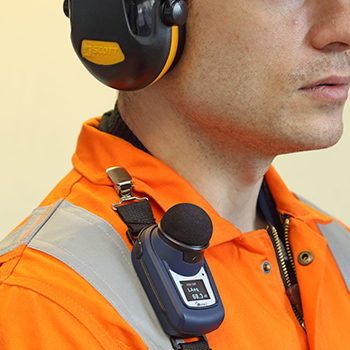
PERSONAL NOISE DOSIMETRY: Wireless, personal noise dosimeters will calculate employees’ time-weighted-average (TWA) noise exposure.
Captures real-world exposure across tasks and environments
Evaluated against OSHA Action Level (85 dBA) and Permissible Exposure Limit (90 dBA)
Adjusted calculations available for extended shifts
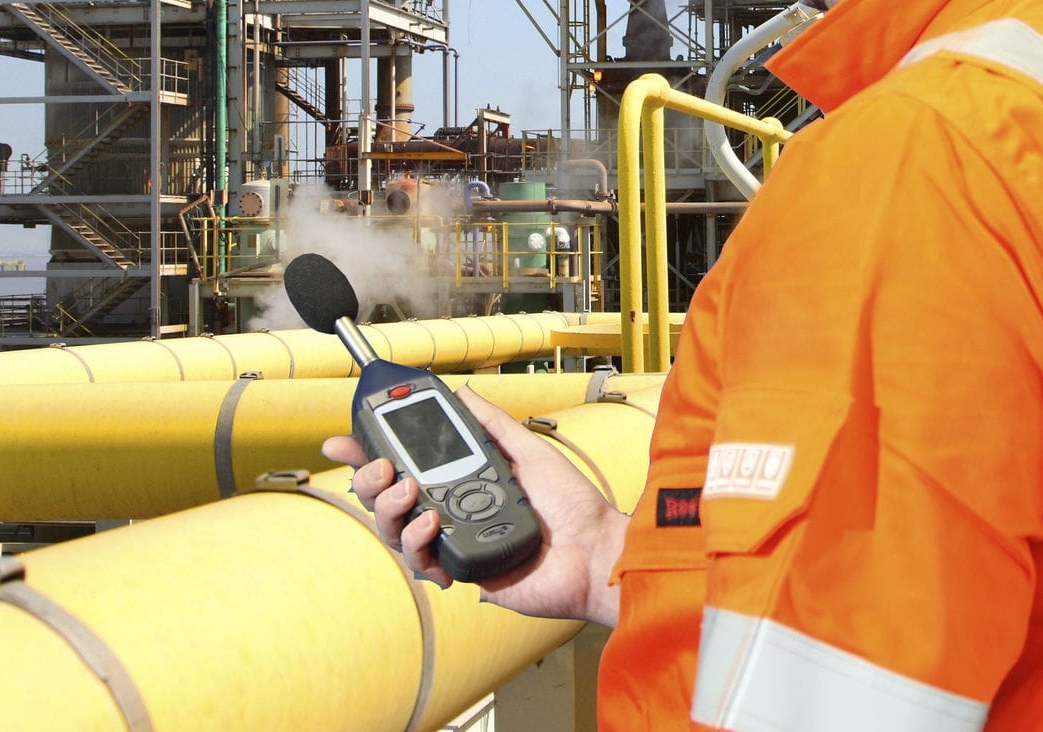
TARGETED SOUND LEVEL MEASUREMENTS: A Type 1 sound level meter is used to measure noise from specific machines, processes, and work areas.
Identifies high-noise equipment and tasks
Supports engineering and administrative control decisions
Provides context to employee exposure data
HEARING PROTECTOR ASSESSMENT: We evaluate your current hearing protection options to ensure they provide adequate attenuation based on measured exposure levels.
Determine if protection meets OSHA requirements
Recommend appropriate NRR selections & Type of Hearing Protection
REVIEW & RECOMMENDATIONS: All findings are analyzed and translated into clear, actionable guidance.
OSHA compliance interpretation
Identify employees requiring inclusion in a Hearing Conservation Program
Practical recommendations to improve safety and reduce risk
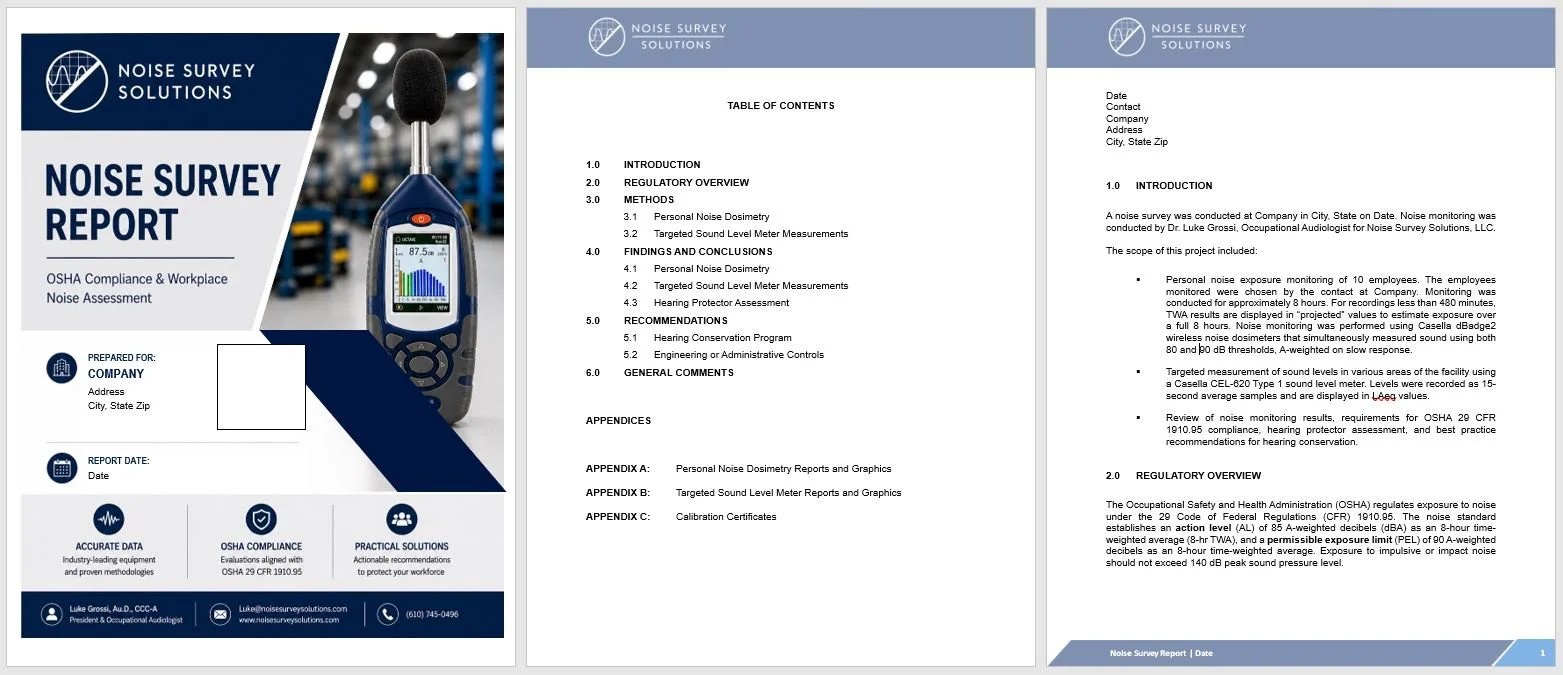
Noise Survey Reporting
Every survey includes a detailed written report designed to serve as both compliance documentation and a decision-making tool.
Reports include:
Color-coded noise exposure data for quick interpretation
Clear explanation of OSHA requirements (29 CFR 1910.95)
Identification of compliance gaps and risk areas
“Best practice” recommendations beyond minimum standards
When exposures exceed or approach regulatory thresholds, additional guidance is provided to ensure proper employee protection and program implementation.
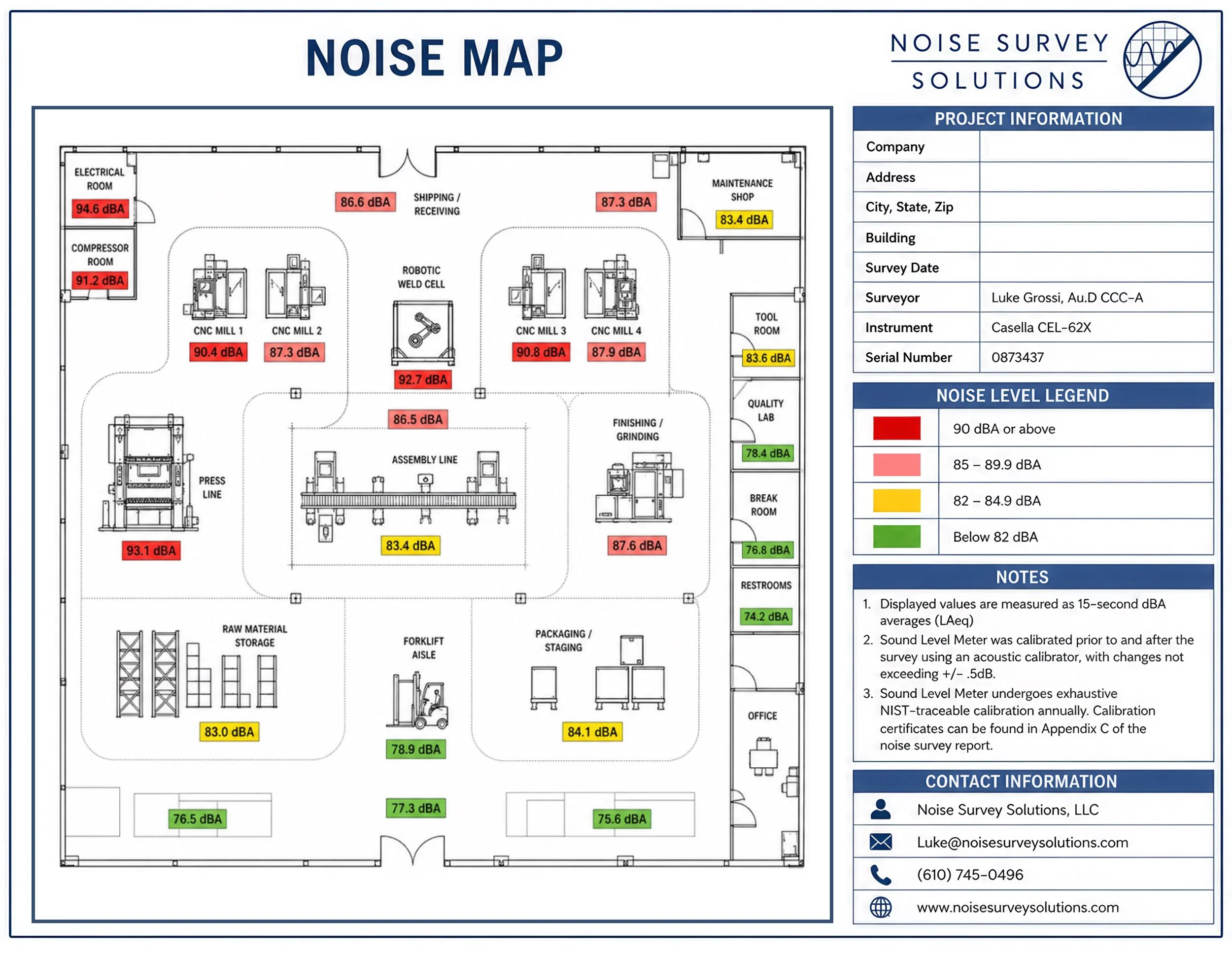
Noise Mapping
Noise data can be plotted on a facility layout to create a visual map of sound levels across your workspace.
Quickly identify high-noise zones
Support engineering and administrative controls
Improve communication with management and employees
Optional service. Additional fees may apply
Custom Hearing Conservation Program Development
Based on findings from the noise survey, we can work with you to develop a custom hearing conservation program designed to maximize employee hearing protection and minimize company liability. Program objectives include:
Identify employees that must be included in a Hearing Conservation Program
Identify areas where hearing protection and/or engineering controls are required
Recommend appropriate hearing protection type and Noise Reduction Rating (NRR)
Document administrative/engineering controls
Outline employee hearing conservation training
Optional service. Additional fees may apply
Noise Map Example